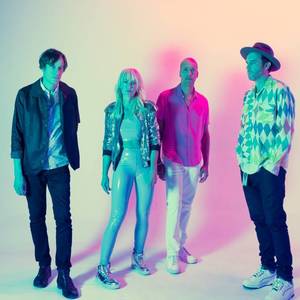
Metric, formed in 1998 by Emily Haines and James Shaw, is a Canadian synth-pop, new wave and indie-rock band, hailing from Toronto, Ontario, Canada.
Metric, originally formed under the moniker Mainstream, was founded in 1998 by Emily Haines and James Shaw. Having studied at the Etobicoke School of the Arts, Haines met future Broken Social Scene member Kevin Drew and the future Stars and Broken Social Scene member Amy Millan, the latter of which Haines briefly formed a band with in 1990. James Shaw is a Boston Music School graduate, as well as a Juilliard Music School graduate, after which he moved to Toronto where he met Haines. By 1998 the pair had moved to Montreal, Canada, and recorded a 5-track EP entitled “Mainstream”, noted for its downtempo and electro style.
In 2000, having caught the attention of London-based producer Stephen Hague, Metric moved to London, UK and signed a publishing deal with Chrysalis Records. Feeling restricted by the deal however, the duo moved back to New York City in November 2000 and began working on their debut album “Grow Up and Blow Away”, which wouldn’t find a released until 2007. The five-track EP “Static Anonymity” arrived in 2001, featuring both upbeat and downtempo songs, and showcasing the group’s electronic layering prowess. In late 2001 looking to expand the scope of their live performance, Haines and Shaw enlisted the services of drummer Joules Scott-Key and bassist Joshua Winstead.
Metric’s first official full-length album “Old World Underground, Where Are You Now?” was released 2003 on Everloving Records. The critically acclaimed release became a stepping stone for the band’s success, aided by the videos “Combat Baby”, “Calculation Theme”, “IOU”, and “Succexy”. The band’s sophomore album “Live It Out”, was released in 2005 by Last Gang Records, significantly out-performing its predecessor, later being certified double platinum in Canada. Supported by the singles “Monster Hospital”, “Poster of a Girl”, and “Empty”, the band promoted the album by touring in support of the Rolling Stones in New York City, and Bloc Party in the UK. Following subsequent touring of the UK, including Reading and Leeds Festival, and the rest of the world, including shows in France, Germany, Brazil, Norway and Japan, the band took a hiatus.
During the hiatus, Haines released two records as Emily Haines & the Soft Skeleton, Shaw opened a recording studio, and Scott-Key and Winstead formed the band Bang Lime. Metric’s subsequent full-length “Fantasies” was independently released in April 2009, marking the group’s most successful to date. Selling over 250,000 in one year, the album led to the group winning the 2010 Juno Awards for Alternative Album of the Year and Band of the Year. In support of the album, Metric played shows at Coachella Music Festival and Ottawa Bluesfest, and performed across Canada alongside Tokyo Police Cub and The Dears.
After contributing to the soundtracks of “Twilight Saga: Eclipse” and “Scot Pilgrim vs. the World”, Metric toured in support of Muse and released the remix album “Fantasies Flashback” in 2011. The full-length “Synthetica” was issued in July 2012 on the band’s own Metric Music International label. Led by the single “Youth Without Youth”, the album once again won the Juno Award for Alternative Album of the Year, and also saw James Shaw win the award for Producer of the Year.
 Syd Taylor


 Log in to your account